

 English
 русский
 Español
Content
- 1 Step One — Calculate Total Cooling Load & Match TD
- 2 Construction Essentials — Fin Spacing, Coil Coatings & Materials
- 3 Defrost Strategy — Match to Temperature & Relative Humidity
- 4 Airflow Configuration & Evaporator Placement
- 5 Efficiency Upgrades — ECM Fan Motors & Electronic Expansion Valves
- 6 Practical Sizing Validation — Common Pitfalls to Avoid
- 7 FAQs — Cold Room Evaporator Selection
- 7.1 What's the ideal evaporator TD for a 38°F produce cold room?
- 7.2 Can I install a medium-temperature evaporator in a freezer below 20°F?
- 7.3 How often should an evaporator in a high-traffic freezer defrost?
- 7.4 Which material coating offers best corrosion resistance for seafood cold rooms?
- 7.5 Why is ECM fan technology critical for commercial evaporators?
- 7.6 Is it better to oversize the evaporator "just in case"?
The right cold room evaporator is selected by matching three core factors: exact heat load calculation (BTU/hr/W), operating temperature range, and defrost method compatibility. For commercial refrigeration, always prioritize evaporators with optimal fin spacing, ECM fan technology, and capacity within ±15% of the total cooling demand to avoid humidity swings or icing. Units incorrectly chosen raise energy costs by up to 23% and cause temperature stratification exceeding 5°F.
Below we deliver a structured, data-driven guide for engineers and facility managers — covering design parameters, defrost strategies, airflow patterns, and selection workflows tailored for professional cold storage applications (fresh produce, frozen food, dairy, and meat aging).
Step One — Calculate Total Cooling Load & Match TD
Before selecting an evaporator, determine the precise cooling requirement. Total load (BTU/h) = envelope gains + product load + infiltration + internal heat (lights, fans, personnel). For typical commercial cold rooms, the evaporator's nominal rating is given at a specific Temperature Difference (TD) — usually between 8°F and 12°F for medium temp, and 6°F–10°F for low temp.
- Medium temperature (35°F – 45°F): Apply TD 8–12°F; evaporator coil operates at 25–30°F, ensuring efficient humidity control (avoiding product dehydration).
- Low temperature / freezer ( -10°F to 28°F): TD of 6–10°F keeps coil temperature well below freezing, reducing defrost frequency. Never use high TD designs in freezers; they lead to rapid frost bridging.
- Include a safety factor of 10–15% to cover door openings or future load increases. Oversizing beyond 20% causes short-cycling and poor moisture removal.
Typical example: A 3,000 cu.ft. cold room at 36°F with 4 daily pallet entries requires approx. 18,000–24,000 BTU/hr. Choose evaporator rated at ~22,000 BTU/hr at 10°F TD for optimum performance.
Construction Essentials — Fin Spacing, Coil Coatings & Materials
Physical design determines longevity and frost tolerance. Commercial evaporators feature either copper-aluminum or all-aluminum coils; for aggressive environments (seafood, pickling rooms), epoxy-coated or HERESITE coating extends life by 2.5x.
Fin Spacing Guide by Application
- 4–6 fins per inch (standard): Best for applications above 34°F (e.g., floral, deli, dry storage). High heat exchange without excessive frost.
- 3–4 FPI (medium-wide): Ideal for temperatures between 28°F – 34°F (meat ripening, fish chillers). Balances defrost intervals.
- 2–3 FPI (wide fin spacing): Critical for freezers below 28°F, blast freezers, and ice cream storage. Prevents ice bridging and reduces defrost energy up to 35%.
Key data: Field tests indicate that evaporators with incorrectly tight fin spacing in low-temp rooms experience 40% more defrost cycles, adding over 1,200 kWh annually per unit.
| Cold Room Type / Temp Range | Recommended Fin Spacing | Defrost Method | Coil Protection |
|---|---|---|---|
| Fresh Vegetables / 36–41°F | 5 FPI | Air / Off-cycle | Hydrophilic coating |
| Dairy & Beverage / 34–38°F | 4–5 FPI | Electric (low density) | Standard Al/Cu |
| Seafood / Meat chiller / 30–34°F | 3–4 FPI | Electric or Hot gas | Epoxy / E-coat required |
| Ice Cream / Frozen / -15–20°F | 2–3 FPI (wide gap) | Heavy-duty electric / Hot gas | Baked phenolic coating |
Defrost Strategy — Match to Temperature & Relative Humidity
Choosing an evaporator without the correct defrost plan leads to excessive downtime and coil damage. For each commercial application, follow these engineering guidelines:
- Air defrost (off-cycle): Suitable only for rooms > 34°F, low humidity (<65% RH). Avoid for walk-in freezers or high-traffic produce storage.
- Electric defrost: Most versatile, ideal for 25°F to 35°F applications and small/medium freezers. Typical energy consumption: 3–7% of total refrigeration load. Modern demand-defrost controllers slash waste by 30%.
- Hot gas defrost: Best for large systems (over 10 HP), low-temp warehouses, and multiple evaporator configurations. Provides the fastest cycle (8–12 minutes) and lowers energy cost.
Evidence-backed selection: If the cold room operates below 32°F and sees more than 12 door openings per hour, avoid air defrost completely. Use electric with termination sensor or hot gas to maintain coil cleanliness. Inefficient defrost raises operational expenses by up to 18% annually.
Additionally, ensure the evaporator includes a robust drain pan heater (for freezers) and anti-frost fan cycling.
Airflow Configuration & Evaporator Placement
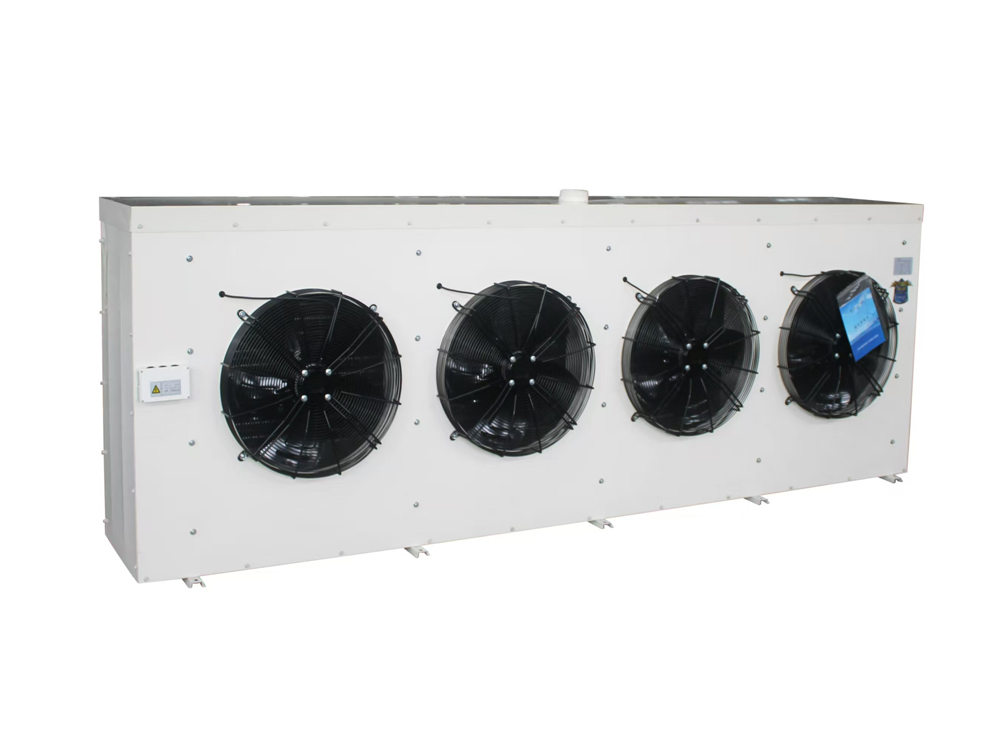
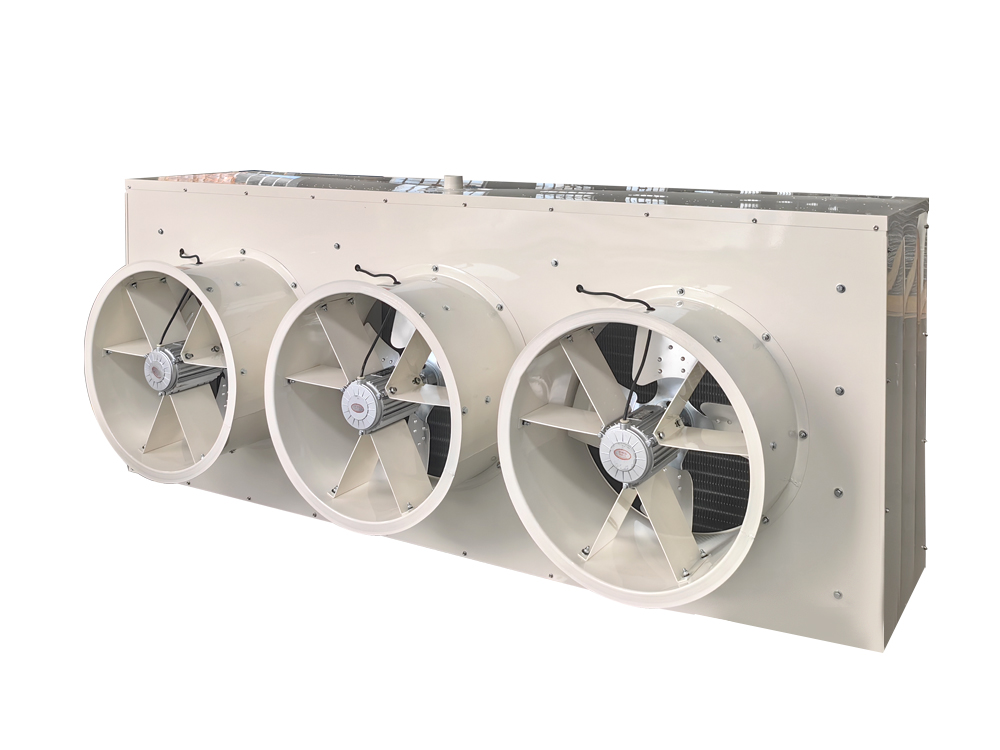
The evaporator's fan system must deliver uniform temperature across the entire cold room. Horizontal throw (ceiling-mounted) works best for narrow, long rooms, while low-profile centrifugal units are ideal for low-ceiling modular coolers.
- Air throw distance: For rooms longer than 30 ft, select evaporators with dual or triple fans delivering at least 1,200 CFM at 0.5 in. static pressure. Under-throw results in temperature gradients >6°F from front to back.
- Air velocity at product level: For sensitive produce (berries, leafy greens), keep below 250 ft/min to prevent moisture loss. For frozen goods, higher velocity (400-500 ft/min) improves freezing rate.
- Always mount evaporator opposite to the main access door, with at least 18 inches clearance from stored goods and walls. Poor positioning reduces effective capacity by up to 27%.
(+infiltration)
Efficiency Upgrades — ECM Fan Motors & Electronic Expansion Valves
Modern evaporators come with Electronically Commutated (EC) motors which consume up to 75% less energy than traditional shaded-pole fans. For a 24/7 cold storage facility, upgrading to EC evaporator fans yields an average payback of 8–12 months.
- Typical 1/4 HP shaded-pole fan: ~280W; ECM equivalent: ~75W under load. Annual savings per evaporator: ~1,800 kWh (based on 8,000 hr run).
- Electronic expansion valves (EEVs) provide precise superheat control, preventing liquid floodback and improving evaporator efficiency by 12–18% compared to mechanical TXVs.
- Demand-defrost controllers (using coil frosting sensors) can cut defrost frequency by 35% while maintaining clean coils.
When sourcing commercial evaporators, specify EC fan technology and adaptive defrost logic — the additional capital cost is typically recovered within 18 months due to energy reduction, especially in freezing applications.
Practical Sizing Validation — Common Pitfalls to Avoid
Even experienced specifiers sometimes misapply evaporator selection. Prevent the following costly errors:
- Oversizing evaporator for low load: Leads to short cycling, poor dehumidification, mold growth in medium-temp coolers.
- Ignoring room humidity profile: High-moisture products require lower TD and wider fin spacing even at medium temperature.
- Mismatched evaporator/condensing unit capacity: Ensure evaporator capacity is within 85%–110% of condensing unit capacity at the same operating conditions.
Pro Tip: Always verify manufacturer performance data at your specific saturated suction temperature (SST) and room air temperature. Generic capacity tables often assume ideal conditions — derate by 8–12% for real-world dirty coils or high altitude.
FAQs — Cold Room Evaporator Selection
What's the ideal evaporator TD for a 38°F produce cold room?
For fresh produce, a TD of 8–10°F is recommended. This keeps coil temperature around 28–30°F, maintaining high relative humidity (85–90%) without excessive frost buildup. Avoid TD >12°F to reduce product dehydration.
Can I install a medium-temperature evaporator in a freezer below 20°F?
No — medium-temp evaporators have narrow fin spacing (4–6 FPI) and insufficient defrost heaters. They will rapidly ice up, causing fan blade damage and airflow blockage. Always select low-temp-specific evaporators with wide fin spacing (2–3 FPI) and heavy-duty defrost.
How often should an evaporator in a high-traffic freezer defrost?
Typically 3 to 6 defrost cycles per day (each 20–30 min for electric). Use demand defrost controllers to reduce unnecessary cycles, cutting energy by up to 30% while protecting coil integrity.
Which material coating offers best corrosion resistance for seafood cold rooms?
Epoxy-coated or E-coat with anti-corrosion treatment (minimum 150 microns thickness) is standard. For extremely saline environments, specify marine-grade (HERESITE or phenolic coating) — this extends evaporator life to 10+ years.
Why is ECM fan technology critical for commercial evaporators?
EC motors reduce fan energy consumption by 60–75% and offer built-in speed control, which helps maintain precise airflow even during low-load conditions. This directly improves temperature stability and lowers operating costs. Most energy codes now favor EC evaporators for new installations.
Is it better to oversize the evaporator "just in case"?
No — oversizing beyond 15-20% causes short cycling, poor latent heat removal, and elevated humidity (leading to mold and frost issues). Always right-size based on calculated load with reasonable 10–15% safety margin.
Final recommendation: The correct cold room evaporator balances capacity, fin geometry, defrost type, and airflow pattern. For any commercial refrigeration project — from walk-in coolers to industrial freezers — using the structured approach above guarantees improved product shelf life, lower energy bills (up to 22% reduction), and extended equipment lifetime.


 Contact Number:+86-18858565929
