

 English
 русский
 Español
Content
- 1 Why Heat and Humidity Shape Workshop Productivity
- 2 What Separates a Workshop Unit from a Household Unit
- 3 Assessing Your Workshop Before You Shop
- 4 Key Features to Evaluate in a Workshop Air Conditioner
- 5 Matching Capacity to Your Workshop Heat Load
- 6 Air Distribution Layouts and Installation Patterns
- 7 Energy Use and Operating Cost
- 8 Installation Planning and Site Preparation
- 9 Maintenance Routine That Protects Performance
- 10 Evaluating Suppliers and Requesting Proposals
- 11 Frequently Asked Questions
- 11.0.1 Q1: What size of workshop air conditioner do I need for a large hall?
- 11.0.2 Q2: Can a workshop air conditioner operate in a heavy dust environment?
- 11.0.3 Q3: How do I know whether a unit suits a humid production area?
- 11.0.4 Q4: Is a custom configuration possible for unusual layouts?
- 11.0.5 Q5: What information should I prepare before requesting a quote?
- 12 Making a Confident Final Decision
Why Heat and Humidity Shape Workshop Productivity
Production halls rarely enjoy the controlled climate of an office. Machines run for long hours, welding and cutting release heat, and large roller doors let humid outside air flow in. Over a full shift these loads combine into zones where the air feels heavy, workers slow down, and sensitive processes drift outside their ideal conditions. Choosing the right cooling equipment is therefore an operational decision as much as a comfort decision.
Output decline frequently reported during prolonged peak-heat periods in plant surveys.
A typical large hall divides into heat-generating machines, assembly stations and storage or staging areas.
Hot and humid air can raise defect rates in moisture-sensitive work such as coating, painting and adhesive bonding.
A workshop air conditioner addresses this problem at the level of the working space rather than the whole building. Instead of trying to cool an entire volume to a comfortable temperature, it targets the zones where people and processes need relief, and it does so with airflow patterns and filtration designed for industrial conditions. The result is a more stable environment at a lower operating cost than many buyers expect.
This guide explains how to assess your workshop, which features deserve the most attention, how to estimate capacity, how layouts affect performance, and what to check when you evaluate suppliers.
What Separates a Workshop Unit from a Household Unit
Household air conditioners are built for intermittent use in quiet, clean rooms. Industrial spaces demand more. Equipment must run for long periods, tolerate airborne particles, and resist moisture and corrosive vapors. Understanding these differences helps you avoid a common mistake: buying a unit that performs well on a specification sheet but struggles on the production floor.
| Feature | Household split unit | Workshop air conditioner |
|---|---|---|
| Duty cycle | Intermittent use | Continuous or long-running operation |
| Airflow | Short throw in one room | Directional, long-throw distribution |
| Dust tolerance | Basic washable filter | Multi-stage filtration modules |
| Housing | Lightweight indoor casing | Corrosion-resistant coated housing |
| Protection | Indoor use only | Splash-resistant rating for harsh areas |
| Serviceability | Limited access panels | Accessible filters, coils and controls |
The differences above are not marketing distinctions. They determine whether a unit will still deliver its rated performance after a year of dust loading, daily washdowns and heavy duty cycles. When reviewing any option, ask how the unit behaves under the conditions you actually have, not only under laboratory test conditions.
- Continuous duty rating matters more than peak cooling output for most shift patterns.
- Filter access and service clearance directly affect maintenance time and downtime.
- Housing material determines how the unit ages in humid or chemical-laden air.
Assessing Your Workshop Before You Shop
The most effective buying decisions begin with a clear picture of the site. Suppliers can recommend models quickly when they receive accurate information, and they can avoid over-specifying equipment when the data is complete. A short site assessment, carried out over one or two shifts, usually provides everything needed for a first proposal.
Measure the Physical Space
- Floor area and ceiling height, including mezzanines and partitions that block airflow.
- Number, size and location of doors, roller shutters and open loading bays.
- Layout of machines, benches and walkways, since these determine where people stand.
Record the Working Conditions
Measure temperature and relative humidity at several points during the hottest part of the day. Note the presence of dust, oil mist, welding fumes or solvent vapors, because each one affects filter selection and coating requirements. Record how many people work in each zone and for how many hours per shift.
Define the Target Outcome
Decide what success looks like before you request quotes. A target might be a specific temperature range at workstation height, a maximum humidity level in sensitive areas, or a noticeable reduction in heat stress complaints. Clear targets allow suppliers to propose a layout that meets your goals rather than a generic configuration that only matches a catalog figure.
Key Features to Evaluate in a Workshop Air Conditioner
Once the site is documented, the next step is to compare features. Five areas deserve the closest attention because they determine real-world performance: air supply design, compressor and heat exchange, filtration, control strategy and housing protection. Each area can be checked with specific questions during supplier discussions.
Air Supply Design and Louvers
Air distribution decides whether cool air reaches the people who need it. Adjustable louvers allow the outlet angle to be set for a particular station, so the unit can deliver directional relief to a workbench or spread air across a wider assembly area. Fixed-direction outlets are simpler but offer less flexibility when the layout changes. A louvered cooling unit is particularly useful in halls where workstations are rearranged frequently, because the outlet can be redirected without new equipment.
Compressor and Heat Exchange Performance
An industrial compressor designed for continuous duty sustains cooling output through long shifts. Pay attention to coil surface area, fin spacing and the quality of the refrigerant circuit. Larger heat exchange surfaces typically improve performance in high-temperature environments, and they can reduce the frequency of cycling, which benefits both comfort and component life.
Filtration for Dust-Prone Environments
Dust is one of the most common causes of premature wear in cooling equipment. A multi-stage filtration module captures coarse particles first and finer particles afterward, protecting the coil and reducing the rate at which the unit loses efficiency. Ask how the filters are accessed, how often they need replacement under your conditions, and whether pre-filters can be cleaned on site.
Variable Frequency Control
Workshops rarely operate at full load all day. A variable frequency drive adjusts compressor and fan speed to match the actual heat load, which reduces electrical consumption during partial-load periods. The savings are most visible in facilities with shift breaks, seasonal swings or zones that are only occupied for part of the day.
Housing Protection and Corrosion Resistance
Housing materials and coatings determine how the unit performs in humid or chemically active air. Look for anti-corrosion finishes on exposed metal, sealed electrical enclosures and a protection rating appropriate for the cleaning methods used on site. A splash-resistant rating such as IPX4 is a useful benchmark for areas where water may reach the unit during washdowns.
- Confirm the air outlet design matches your layout and worker positions.
- Check compressor duty rating and heat exchange surface data.
- Request filtration details, replacement intervals and access requirements.
- Verify the control strategy and expected energy profile at partial load.
- Review housing finish, sealing and protection rating against your environment.
Matching Capacity to Your Workshop Heat Load
Capacity sizing is one of the most misunderstood steps in equipment selection. Floor area is a useful starting point, but it does not capture the heat generated by machines, lighting, people and solar gain through roofs and windows. Two halls of identical size can require very different cooling capacity depending on their processes and occupancy.
| Workshop area (square meters) | Typical load profile | Common planning approach |
|---|---|---|
| Up to 50 | Light assembly with few heat sources | One directional unit |
| 50 to 150 | Mixed assembly and light machining | Two or three units across defined zones |
| 150 to 400 | Heavy machining with continuous operation | Zoned multi-unit layout with balanced airflow |
| Above 400 | High heat load or large open halls | Engineering survey and custom configuration |
The table above is a planning guide rather than a final specification. Suppliers typically confirm the numbers through a site survey that considers the following inputs.
- Internal heat sources, including motors, furnaces, ovens and heated tooling.
- Number of occupants and their activity level during each shift.
- Lighting type and hours of operation.
- Heat entering through roofs, glazing and frequently opened doors.
- Required indoor temperature and humidity targets for each zone.
Oversizing is as problematic as undersizing. An oversized unit cycles on and off frequently, which can leave humidity poorly controlled and increase wear. A carefully matched system runs steadily, holds conditions more consistently and uses energy more efficiently.
Air Distribution Layouts and Installation Patterns
Different layouts suit different halls. The right choice depends on ceiling height, the position of workstations and whether cooling should be targeted or broad. The diagram below compares three common approaches and highlights how the air is distributed in each case.
Ceiling-mounted arrangements distribute air across a broad area and suit halls with uniform heat loads. Wall-mounted louvered units concentrate cooling where people stand and can be angled toward specific benches. Jet fan configurations move air over long distances, which is useful for tall halls and aisle-based layouts, though they usually work best alongside a dedicated cooling source.
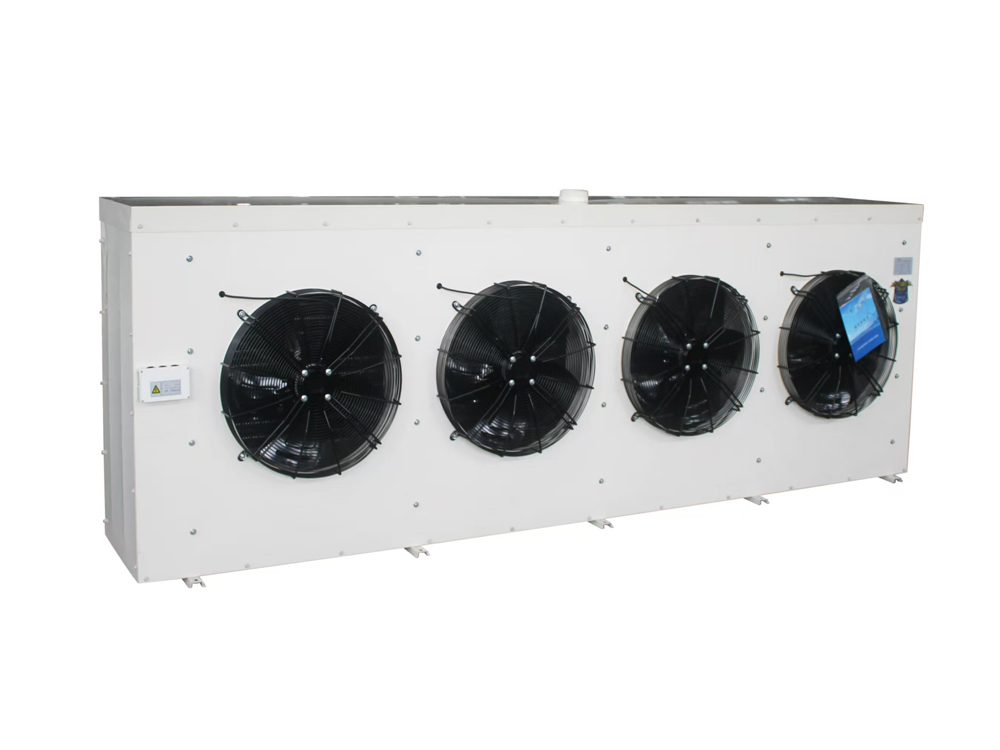
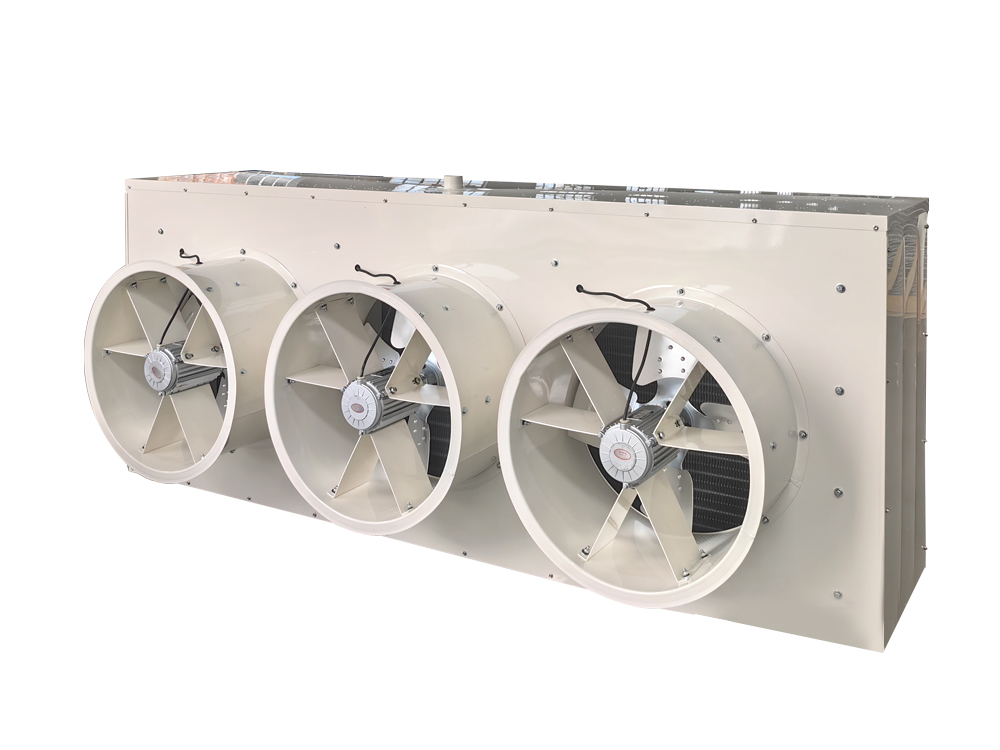
For multi-station halls, a 8P workshop cooling air conditioner with adjustable louvers offers a flexible middle path. It supplies directed air to the workstations that need it most while still helping to lift the temperature of the surrounding space.
- Mount units where they do not blow directly onto the same worker for long periods.
- Keep outlets clear of tall racks or stacked materials that block airflow.
- Position return paths so warm air is drawn back across the coil efficiently.
- Consider exhaust fans and door discipline to limit hot outside air entering the hall.
Energy Use and Operating Cost
Operating cost often exceeds purchase cost over the life of a cooling system. Energy use depends on how well the unit matches the load, how efficiently it runs at partial capacity and how well the building envelope retains cooled air. Small improvements in each area add up across thousands of operating hours.
Most shifts operate below peak load, so part-load efficiency has a large effect on total consumption.
Cooling only occupied areas avoids conditioning empty floor space during breaks and off-shift hours.
- Use variable frequency control so output tracks the real heat load.
- Schedule cooling for occupied zones rather than the whole hall.
- Seal large openings and keep doors closed when not in use.
- Maintain filters and coils, since restricted airflow forces the system to work harder.
- Review energy data after the first summer and adjust settings accordingly.
Ask suppliers for expected consumption at several load points rather than a single rated figure. This comparison reveals how the unit will behave in your actual operating pattern and helps you compare proposals on an equal footing.
Installation Planning and Site Preparation
Good installation is essential to good performance. Even a well-designed unit can underperform if it is mounted in the wrong place, supplied with unstable power or drained poorly. Planning these details before delivery prevents delays and reduces commissioning problems.
Mounting and Clearance
Allow enough clearance around the unit for filter removal, coil cleaning and electrical access. Mounting height should suit the air throw required for the layout, and structural supports must carry the unit weight with appropriate vibration isolation. Confirm these details with the supplier before the mounting position is finalized.
Electrical and Drainage Requirements
- Verify supply voltage, phase and circuit capacity against the nameplate data.
- Install a dedicated isolator within reach of the maintenance team.
- Plan condensate drainage with adequate fall so water does not collect in the unit or on the floor.
- Protect cabling from heat, moisture and mechanical damage along its route.
Commissioning and Handover
Commissioning should include airflow checks at each outlet, temperature and humidity measurements in the target zones, electrical verification and a demonstration of controls. Request written commissioning records so future service teams can compare performance against the original baseline.
Maintenance Routine That Protects Performance
A workshop air conditioner works hard in a demanding environment, so a simple maintenance schedule has an outsized effect on reliability. Most failures in dusty settings are preventable with regular inspection, and most efficiency losses trace back to dirty filters or coils.
- Weekly: inspect pre-filters and clear visible dust from outlets and grilles.
- Monthly: check drainage paths, fan condition and louver movement.
- Quarterly: clean coils, verify electrical connections and review control settings.
- Annually: arrange a full service including refrigerant circuit checks and performance testing.
Keep a simple log of readings, service dates and any unusual noise or vibration. Trends in temperature difference or power draw often reveal a developing fault weeks before it causes a shutdown.
Evaluating Suppliers and Requesting Proposals
Choosing a supplier is as important as choosing the equipment. A capable manufacturer provides engineering support, clear technical documentation and dependable after-sales service. Traders who sell without design capability may struggle to adapt products to unusual layouts or unexpected site conditions.
- Confirm the supplier has in-house design and production capability rather than relying solely on resale.
- Ask for complete technical data, including capacity, duty rating, protection level and filtration details.
- Check whether custom louver patterns, voltage options or housing finishes are available for special sites.
- Review warranty terms, spare parts availability and response times for service calls.
- Request a site survey or written layout recommendation before finalizing quantities.
When you contact suppliers, provide the site data collected during your assessment. Accurate inputs produce accurate proposals, which makes comparison far easier and reduces the risk of costly revisions after installation.
Frequently Asked Questions
Q1: What size of workshop air conditioner do I need for a large hall?
Start with the heat load rather than floor area alone. Consider machines, occupants, lighting, solar gain and door openings, then ask a supplier for a site-based recommendation. Large halls often combine several units across defined zones instead of relying on a single oversized system.
Q2: Can a workshop air conditioner operate in a heavy dust environment?
Yes, provided the unit includes multi-stage filtration and accessible filters. Select a filter schedule that matches the dust level on your site, and confirm that pre-filters can be cleaned or replaced without specialized tools.
Q3: How do I know whether a unit suits a humid production area?
Look for corrosion-resistant housing, sealed electrical components and a protection rating appropriate for washdown or splash exposure. Ask the supplier how the unit performs at your specific humidity levels rather than relying only on standard test conditions.
Q4: Is a custom configuration possible for unusual layouts?
Many manufacturers can adjust louver patterns, mounting arrangements, voltage options and housing finishes to suit special sites. Provide a scaled layout, heat source list and target conditions to receive a configuration that matches your requirements.
Q5: What information should I prepare before requesting a quote?
Prepare floor area, ceiling height, layout drawings, heat source list, occupancy by zone, temperature and humidity targets, dust and vapor conditions, power supply details and any installation constraints. Complete information leads to faster and more accurate proposals.
Making a Confident Final Decision
Selecting a workshop air conditioner is a structured process. Assess the site carefully, define clear targets, match capacity to the real heat load, evaluate air distribution and protection features, and plan installation and maintenance from the outset. Equipment chosen on this basis tends to deliver steady conditions, predictable running costs and fewer surprises during the first years of operation.
If your team is preparing a cooling upgrade, begin by documenting the workshop conditions described in this guide. Sharing that information with a capable supplier allows them to recommend an appropriate configuration. For a practical reference point, review the 8P workshop cooling air conditioner specifications and compare them against your site data.


 Contact Number:+86-18858565929

