

 English
 русский
 Español
Content
- 1 What a Cold Room Condensing Unit Actually Does in a Refrigeration Circuit
- 2 Condenser, Condensing Unit, and Box-Type Enclosure: Clearing Up the Terminology
- 3 Why Box-Type Air-Cooled Condensing Units Suit Cold Storage Projects
- 4 How to Match Cooling Capacity to Cold Room Size and Temperature
- 5 Ambient Temperature and Humidity: The Hidden Sizing Variable
- 6 Installation Space and Airflow Clearance for Box-Type Units
- 7 Design Features That Reduce Maintenance and Extend Service Life
- 8 Customization Options for Project-Specific Cold Room Condensing Units
- 9 Application Scenarios and Layout Considerations
- 10 Comparing Open, Box-Type, and Oblique Upward Blowing Configurations
- 11 Procurement Checklist Before Ordering
- 12 Frequently Asked Questions
- 12.0.1 Q1: What is a cold room condensing unit?
- 12.0.2 Q2: How much does a cold room condensing unit cost?
- 12.0.3 Q3: Is a box-type oblique upward blowing condenser suitable for a small cold room?
- 12.0.4 Q4: Can I get a custom cold room condensing unit for my project?
- 12.0.5 Q5: What maintenance does a box-type condensing unit need?
- 12.0.6 Q6: How do I compare quotations from different suppliers?
- 13 Next Step: Define the Project Data Before Requesting a Quotation
What a Cold Room Condensing Unit Actually Does in a Refrigeration Circuit
A cold room condensing unit is the outdoor or machine-room half of a refrigeration system. It rejects heat absorbed from the cold room and returns liquid refrigerant to the evaporator side. In practical terms, it determines how stable the cold room holds temperature during door openings, product loading, and high-ambient summer periods.
Many cold storage projects fail not because the evaporator is undersized, but because the condensing side cannot reject heat consistently. Common field symptoms include fluctuating condensing pressure, frequent high-pressure trips, water carryover from the condenser fan, dust-clogged coils, and service access blocked by tight equipment rooms. A box-type air-cooled condensing unit addresses these issues through enclosure geometry and airflow direction rather than through electronics alone.
This guide focuses on practical selection logic for contractors, importers, and project integrators. It covers how box-type units differ from open condensing units, how to size capacity against cold room load, how ambient conditions change the required heat rejection surface, and where a plate-type oblique upward blowing box condenser fits into cold storage and heat-pump layouts.
Condenser, Condensing Unit, and Box-Type Enclosure: Clearing Up the Terminology
Buyers often use the terms condenser and condensing unit interchangeably, which leads to mismatched quotations. The distinction matters when comparing offers from different suppliers.
| Term | What It Includes | Typical Project Role | Procurement Note |
|---|---|---|---|
| Condenser | Heat exchange coil, fan, and frame only | Replacement part or field-assembled system | Compressor and controls sourced separately |
| Condensing unit | Compressor, condenser, fan, receiver, and controls | Complete high-side package | Match capacity and refrigerant before ordering |
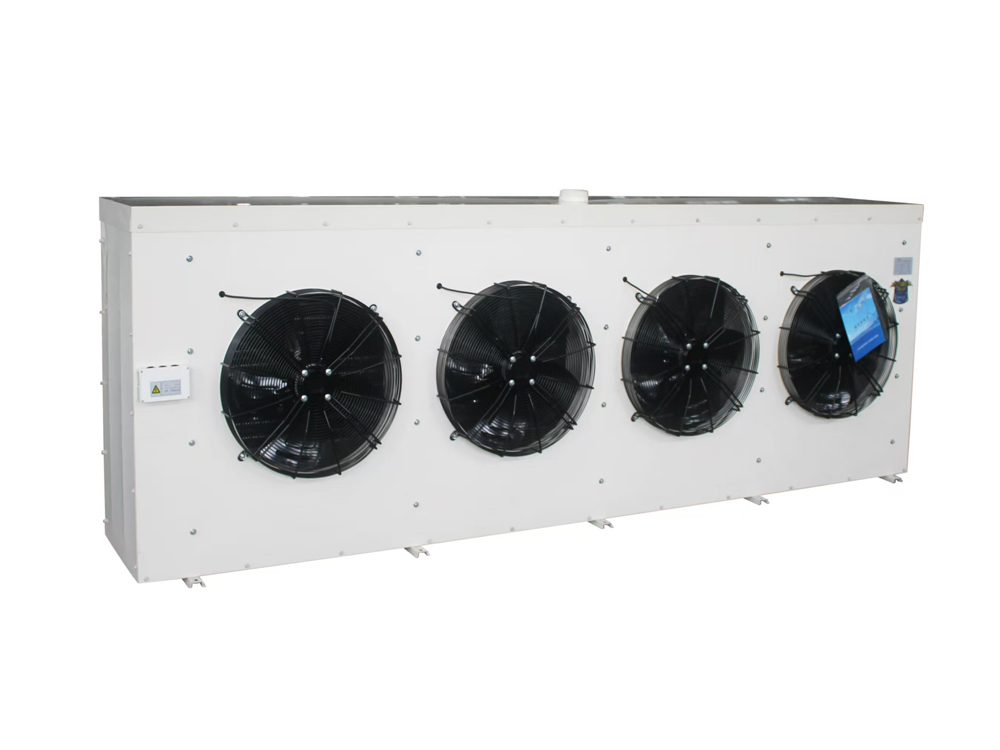
| Box-type unit | Condensing unit inside an enclosed cabinet | Outdoor or semi-outdoor installation | Check airflow clearance and service access |
| Open-type unit | Components mounted on an open frame | Indoor machine rooms with clean air | Lower cost, higher exposure to dust and rain |
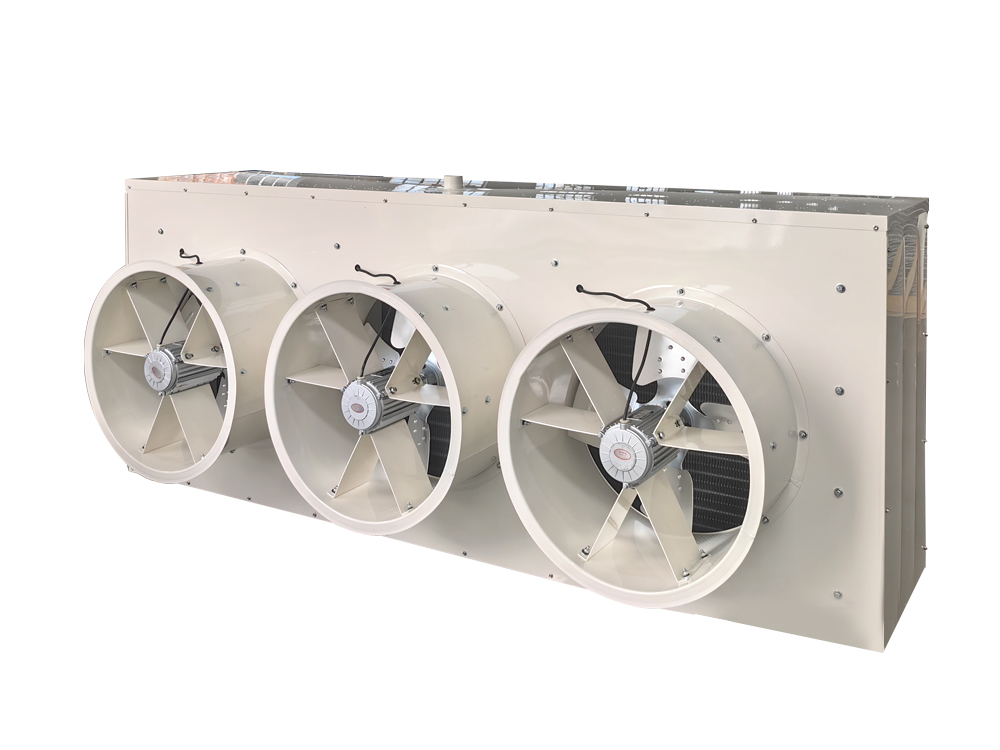
A plate-type oblique upward blowing box condenser is a heat exchange assembly designed to sit inside an enclosed cabinet. Its plate-type coil pack increases effective surface area within a compact footprint, while the oblique upward discharge directs airflow away from the coil face and works with gravity to reduce water droplet carryover. In a full condensing unit, this assembly becomes the heat rejection core paired with a compressor and receiver.
Why Box-Type Air-Cooled Condensing Units Suit Cold Storage Projects
Air-cooled condensing units dominate small and medium cold room projects because they avoid water treatment, cooling towers, and the associated maintenance labor. The box-type enclosure adds a second layer of protection that matters in real installations.
Enclosure Protection Against Dust, Rain, and Debris
Cold storage units are frequently installed on rooftops, beside loading docks, or in partially open equipment yards. An enclosed cabinet shields the coil from airborne dust, packaging fibers, and rain splash. This slows coil fouling and helps maintain heat rejection capacity between service intervals. In dusty grain or feed storage environments, the difference in cleaning frequency can be significant.
Stable Condensing Pressure Across Ambient Swings
When the condenser coil is exposed to direct wind and rain, condensing pressure can swing sharply. Enclosed box units smooth airflow across the coil face, which supports steadier pressure and more predictable compressor operation. For cold rooms holding fruit, vegetables, meat, or pharmaceuticals, that stability translates into fewer temperature excursions.
Compact Layout for Space-Limited Equipment Areas
Urban cold storage retrofits often have narrow equipment rooms or rooftop zones with strict setback rules. A box-type unit with oblique upward discharge can be placed closer to walls than a horizontal discharge unit because the air leaves at an angle rather than straight into an obstruction. This layout flexibility reduces ducting and structural work.
Figure 1: Oblique upward discharge keeps airflow away from the coil face and supports gravity-assisted drainage.
How to Match Cooling Capacity to Cold Room Size and Temperature
Capacity selection starts with the refrigeration load, not with the room volume alone. Two cold rooms with the same cubic meterage can require very different condensing units if one stores chilled produce and the other stores frozen meat.
Step-by-Step Load Estimation
- Calculate transmission load from wall, floor, and ceiling insulation values and the design temperature difference.
- Add product load based on daily intake tonnage, product specific heat, and pull-down time.
- Add infiltration load from door openings, air changes, and worker traffic.
- Add internal loads from lights, forklifts, and defrost cycles.
- Apply a safety margin of 10 to 15 percent for pull-down and future load growth.
The condensing unit must reject the evaporator load plus compressor power input. As a working rule, the heat rejection requirement is roughly the evaporator capacity multiplied by a factor between 1.2 and 1.35, depending on evaporating and condensing temperatures. Suppliers normally publish capacity tables at specific ambient and evaporating conditions; always compare quotations at the same rating point.
| Cold Room Type | Typical Room Temperature | Evaporating Temperature Range | Capacity Selection Focus |
|---|---|---|---|
| Fruit and vegetable fresh storage | 0 to 8 C | -5 to 0 C | Humidity control and small temperature differential |
| Meat and seafood chiller | -2 to 4 C | -10 to -5 C | Fast pull-down and door infiltration load |
| Frozen storage | -25 to -18 C | -35 to -25 C | Low-temperature compressor performance and defrost |
| Pharmaceutical storage | 2 to 8 C | -5 to 0 C | Temperature uniformity and redundancy |
For small cold rooms below roughly 30 cubic meters, a compact box-type condensing unit with a single fan and a plate-type coil is often sufficient. Medium rooms between 30 and 200 cubic meters usually need two-fan or three-fan configurations, and the coil face area should be checked against the required heat rejection at the highest expected ambient temperature.
Ambient Temperature and Humidity: The Hidden Sizing Variable
Catalog capacity is usually rated at 32 C ambient or 35 C ambient. In regions where summer temperatures reach 43 C or higher, the same unit delivers noticeably less capacity. Selection must use the local design ambient, not the catalog reference point.
Humidity adds a second challenge. In coastal and tropical climates, moisture condenses on the coil and must drain away cleanly. An oblique upward blowing arrangement helps because the airflow direction works with gravity rather than driving droplets off the coil face and into the cabinet interior. Combined with a sloped drain pan and a protected discharge path, this reduces water carryover and coil icing at the lower edge.
Practical ambient derating rule
For every 1 C increase in ambient above the catalog rating point, expect roughly 1.5 to 2.5 percent reduction in heat rejection capacity for a standard air-cooled coil. A unit rated at 40 kW at 35 C may deliver only about 34 to 36 kW at 43 C. Always request a capacity table that covers the actual project ambient.
Humidity and Corrosion Protection
High-humidity sites accelerate corrosion on coil fins, fan guards, and cabinet fasteners. Specify coated fins, galvanized or powder-coated cabinets, and moisture-resistant fan motors when the unit will operate near the sea or in food wash-down zones. Enclosure protection grade should match the installation: an IP54 cabinet is common for outdoor units, while wash-down areas may call for higher protection on electrical components.
Installation Space and Airflow Clearance for Box-Type Units
Heat rejection depends on airflow as much as coil surface. A unit packed against a wall or surrounded by stored pallets will recirculate hot air and lose capacity even if the compressor is correctly sized.
- Maintain at least one fan diameter of clear space on the discharge side.
- Keep the coil intake face free of obstructions and away from hot exhaust from other equipment.
- Avoid placing units in recessed corners where hot air can stagnate.
- Provide a service aisle wide enough for coil cleaning and fan motor replacement.
- For oblique upward discharge units, confirm that the discharge plume does not strike an overhead soffit or adjacent wall within the first few meters.
Oblique upward discharge is particularly useful where horizontal clearance is limited. Because the air leaves at an angle, the unit can be positioned closer to a side wall than a straight horizontal discharge model. This is valuable in rooftop retrofits and narrow equipment corridors where every centimeter of setback matters.
Ventilation and Recirculation Checks
Multiple units installed side by side should be spaced so that one unit does not draw in the discharge of another. A common field mistake is arranging three box units in a tight row with discharge facing the same direction and no gap between cabinets. The middle unit then operates in a hot air pocket and runs at elevated condensing pressure. Stagger the units or provide a minimum gap of one cabinet width between adjacent discharge streams.
Design Features That Reduce Maintenance and Extend Service Life
Box-type condensing units differ in coil construction, cabinet rigidity, fan selection, and service accessibility. These details determine long-term reliability more than the compressor brand alone.
Plate-Type Coil Pack
A plate-type coil arrangement packs more heat exchange surface into a given cabinet volume. For projects with limited footprint, this allows a higher capacity unit in the same physical envelope. The plate geometry also supports more uniform airflow distribution across the coil face, which reduces hot spots that can cause localized fouling or frost buildup.
Cabinet Rigidity and Panel Access
Service technicians need removable panels that expose the coil face, fan motors, and electrical box without dismantling the refrigerant piping. Cabinets with flanged panel edges and captive fasteners reduce maintenance time and prevent panel loss. For outdoor installations, panel gaskets and drain openings should be inspected at each service visit.
Fan and Motor Selection
Fan diameter, blade profile, and motor efficiency affect both airflow and noise. Larger slow-speed fans generally produce less noise per unit of airflow than small high-speed fans. For residential-adjacent cold storage, specify low-noise fan options and check the sound pressure level at the nearest boundary.
1.2 to 1.35
Typical heat rejection factor relative to evaporator load
10 to 15%
Recommended capacity safety margin for pull-down
1 fan diameter
Minimum clear space on the discharge side
IP54
Common enclosure protection for outdoor cabinets
Customization Options for Project-Specific Cold Room Condensing Units
Standard catalog units cover many applications, but cold storage projects often require adjustments. Customization should be defined before the quotation stage so that capacity, dimensions, and electrical data are fixed.
| Customization Area | Options | When It Matters |
|---|---|---|
| Heat exchange area | Increased coil rows or plate pack depth | High ambient sites or low-temperature duty |
| Fan configuration | Single, dual, or three-fan; low-noise blades | Noise-sensitive boundaries and capacity scaling |
| Cabinet material | Galvanized steel, powder-coated steel, stainless panels | Coastal, food wash-down, and corrosive environments |
| Electrical supply | Single-phase or three-phase; regional voltages | Import projects with fixed site power |
| Control integration | Pressure switches, fan speed controllers, terminal blocks | Integration with existing plant controls |
| Refrigerant compatibility | Coil and component selection for common refrigerants | Projects with specified refrigerant or retrofit plans |
When requesting a custom configuration, provide the cold room dimensions, target room temperature, design ambient temperature, refrigerant type, power supply, and any footprint constraints. These five data points allow a supplier to propose a capacity table and cabinet drawing without repeated clarification rounds.
Application Scenarios and Layout Considerations
Box-type air-cooled condensing units appear across the cold chain, but each segment stresses the equipment differently.
Food Cold Chain Storage
Fruit and vegetable fresh-keeping rooms need stable temperature and humidity with frequent door openings during harvest season. Meat and seafood freezers need reliable low-temperature performance and effective defrost. In both cases, the condensing unit must handle peak ambient while maintaining condensing pressure within the compressor envelope.
Pharmaceutical Warehousing
Pharmaceutical cold rooms require temperature uniformity and documented performance. Redundancy is common: two smaller condensing units may be preferred over one large unit so that a single failure does not compromise the whole room. Box-type enclosures also simplify cleaning and pest control in regulated facilities.
Commercial Refrigeration and Process Cooling
Supermarket back rooms, central kitchens, and small processing plants use box-type units where equipment space is tight and outdoor placement is required. The enclosed cabinet protects the coil from kitchen grease and flour dust, which are common in food preparation areas.
Heat-Pump Systems with Strict Layout Requirements
Heat-pump projects often face the same space constraints as cold storage. A box-type condenser with oblique upward discharge can fit into a narrow plant area while maintaining adequate airflow. The plate-type coil supports compact packaging without sacrificing heat exchange surface.
Comparing Open, Box-Type, and Oblique Upward Blowing Configurations
The table below summarizes how the three common configurations differ in practical project terms. It is intended to help buyers match the configuration to the installation site rather than to rank one design above another.
| Configuration | Dust and Rain Exposure | Footprint | Water Carryover Risk | Best Fit |
|---|---|---|---|---|
| Open frame | High | Moderate | Moderate | Clean indoor machine rooms |
| Box-type horizontal discharge | Low | Moderate to large | Moderate | Rooftops with open side clearance |
| Box-type oblique upward blowing | Low | Compact | Lower | Narrow equipment areas and high-humidity sites |
The oblique upward blowing arrangement is not a universal replacement for every other design. It is a targeted solution for projects where side clearance is limited, humidity is high, or water droplet carryover would damage nearby equipment or stored goods.
Procurement Checklist Before Ordering
Use this checklist to compare quotations on equal terms and to avoid change orders after the equipment arrives on site.
- Confirm the required capacity at the actual design ambient, not at catalog reference conditions.
- Verify the refrigerant type and the compressor capacity envelope at the expected evaporating temperature.
- Check cabinet dimensions against the available footprint, including service clearance.
- Confirm the discharge direction and clearance to walls, soffits, and adjacent units.
- Review enclosure protection grade and corrosion coating for the site environment.
- Confirm electrical supply, control voltage, and terminal block arrangement.
- Request a capacity table, dimensional drawing, and wiring diagram with the quotation.
- Agree on spare parts, documentation language, and warranty terms before shipment.
Frequently Asked Questions
Q1: What is a cold room condensing unit?
A cold room condensing unit is the high-side package of a refrigeration system. It contains the compressor, condenser coil, fan, receiver, and controls. It rejects heat from the cold room and supplies liquid refrigerant to the evaporator. Box-type versions place these components inside an enclosed cabinet for outdoor or semi-outdoor installation.
Q2: How much does a cold room condensing unit cost?
Price depends on cooling capacity, compressor type, coil surface area, fan configuration, cabinet material, electrical supply, and customization. Small single-fan units sit at the lower end of the range, while multi-fan low-temperature units with coated coils and custom cabinets cost more. Request a quotation with the room size, target temperature, and design ambient to receive an accurate figure.
Q3: Is a box-type oblique upward blowing condenser suitable for a small cold room?
Yes. Compact box-type units with a single fan and a plate-type coil are well suited to small cold rooms where the equipment area is narrow and the unit must resist dust and rain. The oblique upward discharge helps maintain airflow even when side clearance is limited.
Q4: Can I get a custom cold room condensing unit for my project?
Customization is common for cold storage projects. Heat exchange area, fan count and blade profile, cabinet material, electrical supply, and control integration can all be adjusted. Provide the room dimensions, target temperature, ambient conditions, refrigerant, and power supply so that the supplier can propose a matching configuration.
Q5: What maintenance does a box-type condensing unit need?
Routine maintenance includes coil cleaning, fan motor inspection, drain pan checks, fastener tightening, and electrical connection inspection. In dusty or coastal sites, cleaning intervals should be shorter. Keeping the coil face clear and the cabinet panels sealed protects heat rejection capacity and extends service life.
Q6: How do I compare quotations from different suppliers?
Compare capacity at the same ambient and evaporating temperatures, confirm the refrigerant and compressor envelope, check cabinet dimensions and discharge direction, and verify the enclosure protection grade. A quotation that lists only horsepower without a capacity table is difficult to compare fairly. Ask for a capacity table, drawing, and wiring diagram with every offer.
Next Step: Define the Project Data Before Requesting a Quotation
Selecting a cold room condensing unit is a matter of matching heat rejection capacity to the real ambient, the real load, and the real installation space. A box-type air-cooled unit with a plate-type oblique upward blowing condenser offers a practical combination of compact layout, enclosure protection, and stable airflow for many cold storage and heat-pump projects.
To move from general information to a specific proposal, prepare the following: cold room dimensions, target room temperature, daily product intake, design ambient temperature, refrigerant type, power supply, and any footprint or noise constraints. With these details, a supplier can propose a capacity table and cabinet drawing that fits the project rather than a generic catalog unit.
Ready to specify the condensing side of your cold room?
Submit your project parameters and request a configuration proposal with capacity table, dimensional drawing, and quotation.


 Contact Number:+86-18858565929

